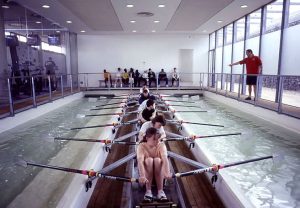
Rowing tanks are used to teach rowing to beginners, to improve the technique of more experienced rowers, and as a training environment in bad weather. The modus operandi has been for the rowers to push the water round the tank, sitting in rowing stations fixed to concrete and using oars resembling sticks of wood. The experience is unrealistic, a chore for experienced athletes, and difficult for beginners to master, leaving them unprepared for the feel of a real boat. An ‘eight’, its rowers, cox, and oars weigh about 1 tonne (1000kg). When on water, the rowers’ energy is spent pulling (or pushing) themselves through the water, overcoming the drag on the shell of the boat – altogether equivalent to each rower pulling 125kg through the water. In traditional tanks, four rowers sit on the site of each channel and have to move approximately 20 tonnes of water past themselves. With normal rowing oars, this is about 40 times harder than rowing a real boat on water. The oars are torn through the water and the feel of the rowing stroke is not accurately reproduced. Also, traditional tanks are generally limited to rowing and cannot accommodate sculling. As part of the London Regatta Centre project, Arup examined these issues from first principles, and produced a revolutionary design that moves the water past the rowers, thus creating the feel of rowing in a boat on water and providing an excellent environment for teaching, developing, and training. Water is powered by submersible electric pumps through hydraulically efficient channels, the flow adjustable electronically to simulate speeds up to 3m/sec. A rowing frame provides rowing stations that represent the layout and structure of a boat, allowing rowers to sit behind each other as they would in the boat.